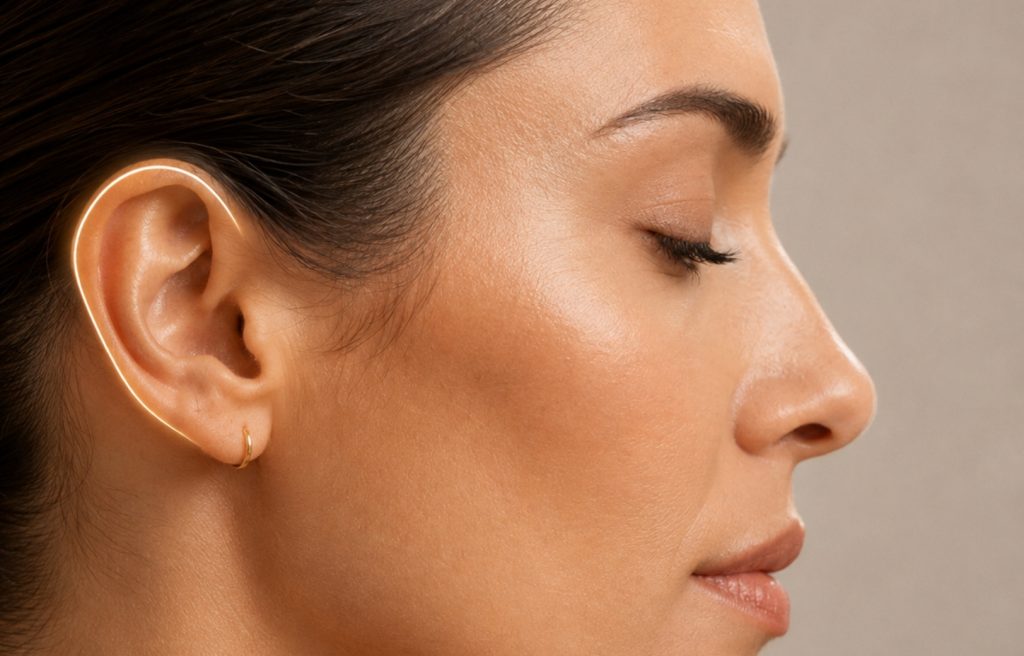
What Is Otoplasty?
Otoplasty is a surgical procedure that modifies the cartilage and soft tissues of the outer ear. Depending on the patient’s anatomy and goals, surgery may create or strengthen natural cartilage folds, reduce excess cartilage, reposition the ear closer to the scalp, reshape an enlarged earlobe, or correct differences between the ears. Incisions are commonly placed in the crease behind the ear, where scars are generally well concealed.
Otoplasty Glossary
| Term | Definition |
|---|---|
| Antihelical fold | The natural inner fold of cartilage that helps define the upper ear. |
| Auricle or pinna | The visible external portion of the ear. |
| Conchal cartilage | The bowl-shaped cartilage near the ear canal that can contribute to ear prominence. |
| Ear pinning | A common type of otoplasty that brings prominent ears closer to the head. |
| Macrotia | An ear that is larger than expected in proportion to the face. |
What Can Otoplasty Improve?
Otoplasty can improve facial balance and confidence related to ear appearance by addressing a variety of concerns, including:
- Ears that project prominently (stick out) from the head
- An underdeveloped or poorly defined antihelical fold
- Excess or deep conchal cartilage
- Differences in ear shape, position, or projection
- Disproportionately large ears or earlobes
- Changes caused by prior surgery or injury
Who Is a Candidate for Otoplasty?
Otoplasty may be appropriate for patients who:
- Are bothered by prominent, asymmetric, or disproportionate ears
- Have stable ear anatomy and realistic expectations
- Are in good overall health and can safely undergo surgery
- Do not use nicotine or are able to stop as directed
- Can follow postoperative dressing and activity instructions
- Understand that perfect symmetry cannot be guaranteed
Otoplasty can be performed in children, adolescents, and adults. In children, the ears should be sufficiently developed and the child should be able to participate willingly in the recovery process. The timing of surgery is individualized after discussion with the patient and family.


How Is Otoplasty Performed?
Otoplasty is usually performed as an outpatient procedure. Anesthesia may include local anesthesia with sedation or general anesthesia, depending on the patient’s age, treatment plan, and comfort. Through carefully positioned incisions, the surgeon uses one or a combination of the following techniques:
- Cartilage suturing: Permanent internal sutures may be used to create or strengthen the antihelical fold and to adjust the position of the ear while preserving cartilage structure.
- Conchal repositioning or reduction: When a deep or enlarged conchal bowl contributes to ear prominence, the cartilage may be repositioned closer to the scalp or conservatively reduced.
- Earlobe or other ear reshaping: The procedure may be modified to address enlarged, protruding, torn, or asymmetric earlobes and other localized contour concerns.
The goal is to create natural contours without an overcorrected or tightly pinned appearance.

Our Otoplasty Surgeons
At UVA Aesthetic Plastic Surgery, our highly regarded surgeons offer expertise and personalized care for a rewarding patient experience.

What Is Otoplasty Recovery Like?
Patients typically return home the day of surgery wearing a protective head dressing that is replaced by a soft headband for a period determined by their surgeon. The schedule varies with technique, healing, and activity level.
After otoplasty, many patients return to nonstrenuous work or school in approximately 1 week, depending on swelling, comfort, and dressing requirements. Activities that could bump or bend the ears are restricted longer.
Light walking is encouraged, but strenuous exercise, heavy lifting, contact sports, and activities requiring helmets are restricted during early healing. Your surgeon will provide individualized instructions.
Recovery Timeline
While experiences vary with the specifics of the surgery and individual patient factors, recovery after otoplasty generally follows this timeline:
Week 1
- A protective head dressing or supportive wrap is commonly worn after surgery.
- Swelling, bruising, pressure, itching, and mild discomfort are expected.
- The ears should be protected from pressure, rubbing, and accidental bending.
- Sleeping on the back with the head elevated is typically recommended.
- Many patients return to school or nonstrenuous work within approximately 1 week.
- Dressings and incision care should be followed exactly as directed.
Weeks 2-4
- Most visible bruising and swelling improve gradually.
- A soft headband may be recommended, particularly at night.
- Contact sports, helmets, and activities that could bend or injure the ears remain restricted until cleared by your surgeon.
- Temporary numbness, tenderness, or firmness may persist.
Long Term
- The ears continue to soften and settle over several months.
- Incisions typically fade within the natural crease behind the ear.
- Minor differences between the ears are normal.
- Final contour and scar maturation may take several months.
- Results are generally long-lasting, although the ears continue to age naturally.
What Are the Risks of Otoplasty?
As with any surgery, otoplasty has potential risks, which may include bleeding or hematoma, infection, delayed wound healing, unfavorable scarring, temporary or persistent changes in sensation, pain, asymmetry, contour irregularity, visible or palpable sutures, suture reaction, skin injury, overcorrection, undercorrection, recurrence of prominence, and the possible need for revision surgery. During your consultation, your surgeon will review the risks that apply to your anatomy and treatment plan.
Why Choose UVA Aesthetic Plastic Surgery?
- Experienced plastic surgeons with specialized facial aesthetic training
- Detailed evaluation of ear cartilage, facial proportions, and symmetry
- Individualized techniques designed to preserve natural ear contours
- Academic medical center resources and safety standards
- Age-appropriate counseling for adults, adolescents, and families
- Comprehensive postoperative care and follow-up
Insight From UVA Plastic Surgeons
Otoplasty is designed to improve balance rather than make both ears perfectly identical. Swelling can temporarily exaggerate asymmetry, and the cartilage requires time to stabilize in its new position. Protecting the ears from pressure and bending during early recovery is important. Although results are generally long-lasting, a small degree of relaxation or recurrent prominence can occur.

Otoplasty FAQ
Will the scars be visible?
Scars are generally difficult to see from the front because we typically place the incisions within the crease behind the ear. The hair often conceals them as well. Additional incisions may be needed for certain concerns. Scars are initially pink or firm and usually fade over time, although no surgical scar disappears completely.
Will my ears look pinned back?
The goal is a natural position that complements the face, not an overly tight or flattened appearance. Surgical planning considers the upper, middle, and lower portions of each ear so the result remains balanced. Some patients may find that they look at their ears more after surgery compared to before, and initially the new position may feel “pinned.”
Can otoplasty make my ears smaller?
Yes, selected techniques can reduce the size of an enlarged ear or earlobe. However, many patients who feel their ears are too large primarily have excessive projection, which may improve with repositioning alone.
At what age can otoplasty be performed?
Otoplasty may be considered once the ears are sufficiently developed and the patient can cooperate with postoperative care. For children, readiness and personal interest in surgery are important and are discussed with the family during consultation.
Are the results permanent?
Otoplasty produces a long-lasting structural change. The cartilage and soft tissues continue to age, and a small amount of relaxation can occur over time. Recurrence requiring revision is uncommon but possible.
Will otoplasty affect my hearing?
Cosmetic otoplasty reshapes the external ear and generally does not involve the structures responsible for hearing. The surgery is not intended to improve hearing.
Your Next Step
To learn more about otoplasty at UVA Aesthetic Plastic Surgery in Charlottesville, request a consultation with one of our plastic surgeons using the online form or call (434) 924-5078 for an appointment.

Reviewed for clinical accuracy by an UVA Aesthetic Plastic Surgery Medical Editor on October 2nd, 2026.